The Subspace Topology
\[\newcommand{\ds}{\displaystyle} \newcommand{\curlies}[1]{\left\lbrace #1 \right\rbrace} \newcommand{\T}{\mathcal T} \newcommand{\Ext}{\text{Ext}} \newcommand{\B}{\mathcal B} \newcommand{\Sp}{\mathbb S}\]Subspace Topology
Let $(X, \T)$ be a topological space, and $A \subseteq X$ be a subset. We define the subspace topology on $A$ as
\[\T_A = \curlies{ U \cap A : U \in \T}\]Proof that $\T_A$ is a topology
-
$\emptyset$ and $A$
- $\emptyset \in \T_A$ since $\emptyset \in \T$
- $X \in \T$, so $X \cap A = A \in \T_A$
-
Arbitrary unions
-
suppose $ \curlies{U_i}{i \in I} \subseteq \T $, then $\ds \bigcup{i \in I} U_i \in \T$
-
for each $i \in I$, $U_i \cap A \in \T_A$
-
$\ds \bigcup_{i \in I} (U_i \cap A) = \left( \bigcup_{i \in I} U_i \right) \cap A \in \T_A$
-
-
Finite intersections
- suppose $U_1, …, U_n \subseteq \T$, then $\ds \bigcap_{i=1}^n U_i \in \T$
- $\ds \bigcap_{i=1}^n (U_i \cap A) = \left( \bigcap_{i=1}^n U_i \right) \cap A \in \T_A$
We say $A$ is a subspace of $X$ to mean $A \subseteq X$ with the subspace topology.
- if $B \subseteq A$ is open (or closed) in $(A, \T_A)$, we say $B$ is open (or closed) relative to $A$
- we need to be precise, because $\T_A \not \subseteq \T$
- thus if $B$ is open relative to $A$, that does not necessarily mean that $B$ is open relative to $X$
Example - $\Sp^1 \subseteq \R^2$
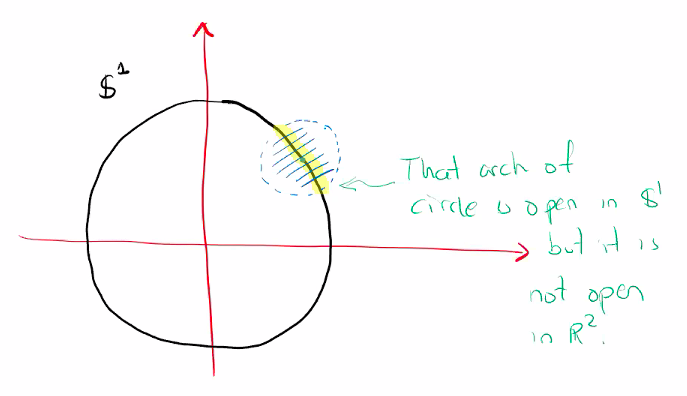
When are open sets in a subspace open in the original set?
If $A \subseteq X$ is open in $X$, then $\T_A$ consists of all open sets of $X$ inside of $A$, so $\T_A \subseteq \T$.
- to prove this, consider that intersections of open sets are open, and $\T_A$ is defined by intersecting $A$ with open sets
Similarly, if $C \subseteq X$ is closed then the closed subsets of $(C, \T_C)$ are the closed sets of $\T$ which are subsets of $C$.
Definition by pullback
$A \subseteq X$ comes naturally with an injection $\iota_A : A \to X$, $\iota_A: x \mapsto x$, called the inclusion map.
We can define a set of subsets by “pullback”:
\[\curlies{\iota_A^{-1}(U) : U \in \T}\]However, notice that for each $U \subseteq X$, $\iota_A^{-1}(U) = U \cap A$, so this pullback is equal to $\T_A$!
The result below shows how this sort of definition allows us to define a subspace topology by deciding which functions are continuous.
Continuity of $\iota_A$ when $A$ is a subspace
$\iota_A: (A, \T_A) \to (X, \T)$ is continuous, and $\T_A$ is the smallest topology where this is true.
Proof.
Let $U \in \T$ be open, then $\iota_A^{-1}(U) = U \cap A \in \T_A$, so $\iota_A$ is continuous.
Any topology that makes $\iota_A$ continuous requires by definition that every inverse image of an open set in $\T$ is open, so $\T_A = \curlies{ \iota_A^{-1}(U) : U \in \T}$ must be a subset of any topology on $A$ where $\iota_A$ is continuous.
This means that $\iota_A$ is continuous iff the topology on $A$ contains $\T_A$.
Characteristic property of subspace topology
Suppose $(X, \T)$ is a topological space.
Part 1:
Suppose $S \subseteq X$ is a subspace. Then $(S, \T_S)$ satisfies $(P_S)$: a map $f: Y \to S$ is continuous if and only if the composite map $\iota_S \circ f : Y \to X$ is continuous.
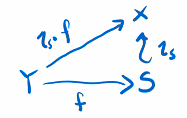
Part 2:
If $S \subseteq X$ is any subset, then the only topology that on $S$ that satisfies $(P_S)$ is the subspace topology.
Proof.
Part 1:
Suppose $S$ is a subspace of $X$.
($\Rightarrow$) Suppose $f: Y \to S$ is continuous, then $\iota_S \circ f : Y \to X$ is continuous, because it is the composition of continuous functions
($\Leftarrow$) Suppose $\iota_S \circ f$ is continuous, then we need to prove that $f$ is continuous. Let $U \subseteq S$ be an open set in $S$, then we can find an open set $V \subseteq X$ with $U = V \cap S$. Then,
\[\begin{align} f^{-1}(U) &= f^{-1}(V \cap S) \\ &= f^{-1}(\iota_S^{-1}(V)) \\ &= (\iota_S \circ f)^{-1}(V) \end{align}\]$\iota_S \circ f$ is continuous, so $(\iota_S \circ f)^{-1}(V) = f^{-1}(U)$ is open. Thus $f$ is continuous.
Part 2:
Suppose $S \subseteq X$ with a topology $\T’$ and $(P_S)$ holds.
We need to prove that $\T’ = \T_S$, the subspace topology.
Let $I_S: (S, \T_S) \to (S, \T’)$ be the identity map. $(S, \T’)$ satisfies the characteristic property, so we can pick $Y = (S, \T_S)$ and $I_S = f:Y \to S$.
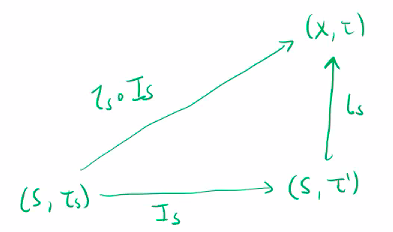
The function $\iota_S \circ I_S$ is the identity map from $(S, \T_S)$ to $(X, \T)$, so it is an identity from a subspace of $X$ to $X$, so it is continuous. By $(P_S)$, this means that $I_S$ is also continuous. Thus, if $U \subseteq S$ is open in $\T’$, then $I_S^{-1}(U) = U$ is also open in $\T_S$. This implies $\T’ \subseteq \T_S$.
Doing the same thing with $I_S’: (S, \T’) \to (S, \T_S)$ we get $\T_S \subseteq \T’’$, so $\T’ = \T_S$.
The identity map is a homeomorphism iff topologies are equal
Let $\T_1, \T_2$ be topologies on $X$. Then the identity map $id_X : (X, \T_1) \to (X, \T_2)$ is a homeomorphism if and only if $\T_1 = \T_2$.
$id_X$ is continuous iff for all open sets $U \in \T_2$, the preimage $id_X^{-1}(U) = U \in \T_1$, so it is continuous iff $\T_2 \subseteq \T_1$.
Similarly, $id_X^{-1}$ is continuous iff $\T_1 \subseteq \T_2$.
Thus, $id_X$ is a homeomorphism if and only if they are equal.
Subspaces work nicely with continuity
Let $f: X \to Y$ be continuous.
- If $S \subseteq X$ is a subspace, then $f\vert_S : S \to Y$ is continuous
- If $S \subseteq Y$ is a subspace, then restricting the codomain $f_S : X \to S$ is continuous
- If $Y \subseteq Z$ is a subspace, then $f_Z: X \to Z$ is continuous
Proof.
- $f\vert_S = f \circ \iota_S$ which is a composition of continuous functions, so it is continuous
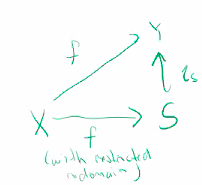
- $f_Z = \iota_Y \circ f$ is a composition of continuous functions, so it is continuous
Example: Isometries on $\Sp^2$
Recall that $\Sp^2 \subseteq \R^3$ is the unit sphere. Let $A \in \mathcal L(\Sp^2)$ be a linear isometry, so $\langle Ax, Ay \rangle = \langle Ax, Ay \rangle$. Prove it is continuous when $\Sp^2$ is a subspace of $\R^3$.
Proof.
A is a linear operator, so it is a continuous function on $\R^3$.
Then the restriction $A: \Sp^2 \to \R^3$ is continuous.
Because $A$ is an isometry, $A(\Sp^2) \subseteq \Sp^2$. Then we can restrict the codomain and see that $A : \Sp^2 \to \Sp^2$ is continuous.
Example: Invertible $2 \times 2$ matrices
Consider invertible matrices in $\R^4$
\[\begin{pmatrix} a & b \\ c & d \end{pmatrix} \in \R^4,\ ad - bc \neq 0\]The space of these matrices given the subspace topology from $\R^4$ is called $GL(2, \R)$.
Then the matrix inverse map
\[\begin{align} i : &\ GL(2, \R) \to GL(2, \R) \\ &\ \begin{pmatrix} a & b \\ c & d \end{pmatrix} \mapsto \frac{1}{ad - bc} \begin{pmatrix} d & -b \\ -c & a \end{pmatrix} \end{align}\]is continuous, as it is a continuous map from $GL(2, \R)$ to $\R^4$ with its range restricted to the subspace $GL(2, R)$.
Nice properties of subspaces
Let $X$ be a topological space
- If $A \subseteq B \subseteq X$, then $\T_A = (\T_B)_A$ - so the subspace topology of $A$ in $X$ is the same as the subspace topology of $A$ in the subspace $B$
- Suppose $\B$ is a basis for $X$. The set $\B_A = \curlies{A \cap B: B \in \B}$
- If $X$ is Hausdorff, second-countable, or first-countable, then so are its subspaces
Proof.
- Suppose $A \subseteq B \subseteq X$.
We define the inclusion maps $\iota_A : A \to X$, $\iota_B : B \to X$, and $\iota_A^B: A \to B$.
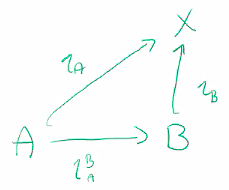
Consider $B$ as a subspace of $X$, then it satisfies the characteristic property. Then, no matter what topology $A$ has, $\iota_A^B$ is continuous iff $\iota_A$ is continuous.
If we choose $A$ to have the topology $\T_A$, then $\iota_A$ is continuous, so $\iota_A^B$ is continuous, so $(\T_B)_A \subseteq A$.
If we choose $A$ to have the topology $(T_B)_A$, then $\iota_A^B$ is continuous, so $\iota_A$ is continuous, so $\T_A \subseteq (\T_B)_A$.